

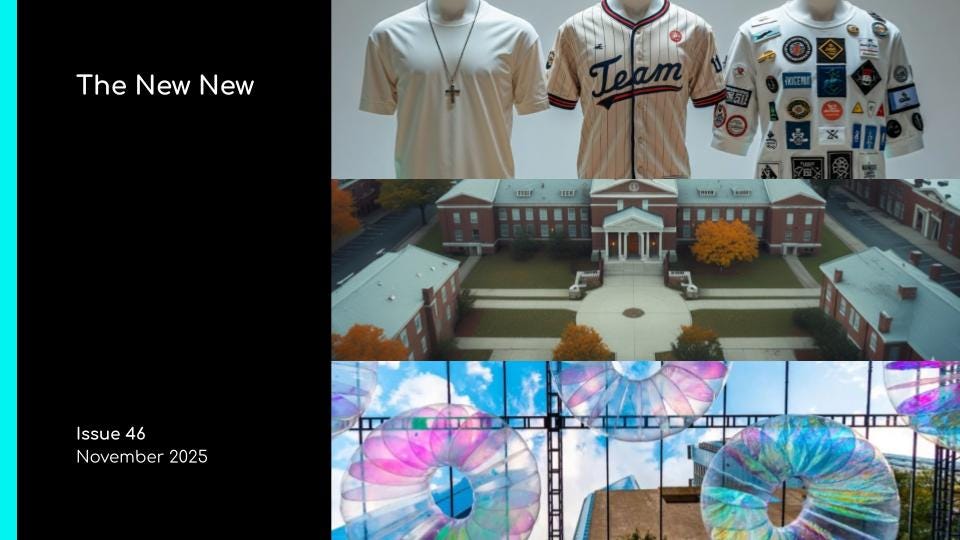
We’ve been building toward something across the last three issues.
After exploring how friction became a feature and how scarcity became a strategy, this final piece reveals what both point to: how consumption has become identity performance in a world where the old anchors have dissolved.
Then: college towns’ greying realization, another roundup of intrigue and irreverence, and a shimmering oculus.
Let’s roll on in.
The Symbolic Economy
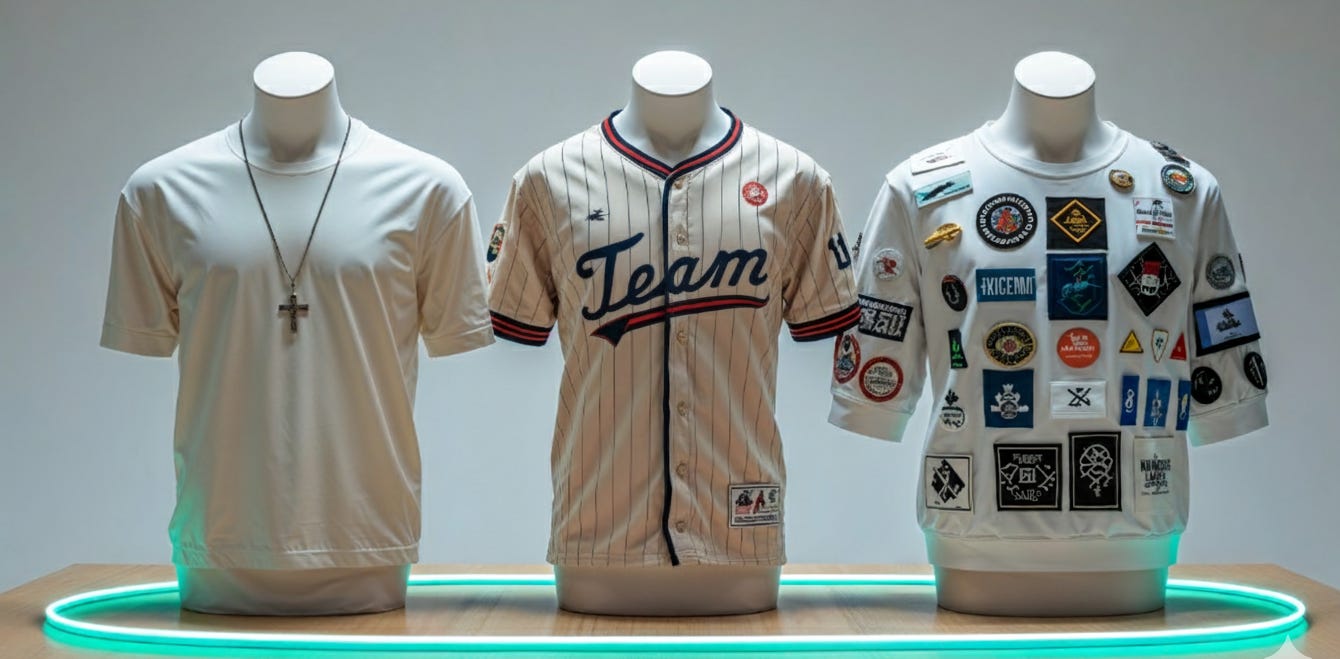
The economy now runs on narratives and symbolic value as much as supply and demand. Bible sales surged 22% last year. People wear brand logos like team jerseys. In a monoculture world, we’re buying proof of identity.
For most of human history, identity was local. Your village determined your world. Your guild shaped your craft. Your church or temple anchored your beliefs. The clothes you wore, the food you ate, the rituals you kept. All of it visible, tangible, daily. All of it said: this is who I am, this is where I belong.
Then, identity scaled.
Cities grew. Regions formed. New markers emerged: the newspaper you carried on the morning train, the sports team whose colors you wore on Saturdays, the political party whose rallies you attended. Still local enough to see and touch, but bigger. More connected. More chosen.
Now we live in something else entirely. A globally connected world where geography no longer dictates culture. We stream the same shows. Scroll the same feeds. Shop from the same platforms. The rise of global monoculture has flattened the distance between us, making the world feel both infinitely large and strangely uniform.
The need for identity remains. The anchors have moved.
The Signal in the Sales
Bible sales are surging in the United States. In 2024, sales jumped nearly 22 percent, marking one of the strongest years for scripture purchases in recent memory.
At the same time, Chipotle Mexican Grill continues to resonate culturally. The brand has become shorthand for a specific kind of consumer: someone who cares about ingredients, values transparency, and wants their burrito to signal something about who they are.
In her piece "How Bible Sales and Chipotle Explain the Economy,” kyla scanlon argues that these two data points reveal something essential about how the economy now works. Supply and demand no longer tell the full story. What matters now are signals, narratives, and beliefs. She calls it the “casino economy,” a system where vibes matter as much as fundamentals, where the framing of a product matters more than the product itself.
Scanlon is onto something: We are seeing a shift that goes deeper than economics.
What Bible sales and Chipotle reveal goes beyond market mechanics. In a globally connected, culturally flattened environment, people are adapting. They buy proof of who they are.
How the Symbolic Economy Works
This is identity as transaction.
When someone buys a Bible in 2025, the purchase extends beyond scripture. The transaction affirms a set of values, aligns with a tradition, and makes visible what someone stands for in an era of uncertainty. When someone orders from Chipotle instead of a dozen other burrito options, the choice signals transparent supply chains, customizable bowls, and a brand that positions itself as aligned with personal values.
These transactions carry meaning that extends far beyond utility.
Look around. People wearing custom-tailored suits covered in Salesforce logos at conferences. Collectors lining up for limited-edition sneakers they will never wear. Communities are forming around specific creators, brands, or products with the same intensity once reserved for churches and civic groups.
Consumption has become identity performance. In a world where everyone has access to the same content and products, what you choose to buy becomes one of the few ways left to differentiate yourself.
This is the symbolic economy.
Brands as the New Moral Authorities
Bible sales and Chipotle trends matter because both fill a gap left by the erosion of traditional institutions.
Fewer people seek guidance from press, priests, and politicians.
Study after study shows that trust in traditional institutions is declining, while expectations for brands to act as moral authorities are rising. People now expect companies to take a stand on social issues, align with their values, and be transparent about their impact on the world.
In “When Exclusivity Scales,” we examined how brands are leveraging scarcity as a strategic tool, limiting access and creating moments that feel rare. But scarcity alone no longer suffices. What people want now goes deeper: they want to feel like stakeholders, not just customers. They want brands that see them, hear them, and reflect their values back to them.
People want to invest in brands emotionally, socially, and financially. They want to be part of something that aligns with who they are and who they want to become.
Brands respond by becoming the new anchors. The institutions we once turned to for meaning, belonging, and moral clarity are being replaced not by new religions or civic groups, but by the companies whose products we buy, whose logos we wear, and whose stories we tell ourselves.
Engineering Symbolic Value
If consumption has become a form of identity performance, then the brands that win will be the ones that engineer symbolic value, not just utility.
This is where “Designing for Effort” becomes relevant.
In a world of seamless transactions and instant gratification, friction can become a valuable feature when intentionally designed. The effort required to participate signals authenticity. The depth of engagement reinforces identity.
Think about the rituals people create around their favorite brands. Unboxing videos. Loyalty programs. Collector communities. Exclusive drops. These go beyond marketing tactics. They are identity-reinforcement mechanisms. They give people something to do, something to show, something to belong to.
The brands that understand this are designing experiences that go beyond the product. They create badges that people can wear, stories that people can tell, and communities that people can join. They sell proof of self.
This makes the symbolic economy different from previous models of consumption. Owning more matters less than aligning with meaning.
What This Means for What Comes Next
As global monoculture deepens, this pattern will intensify.
The brands that help people feel distinct within a sea of sameness will dominate.
The brands that engineer belonging, reinforce identity, and treat customers as stakeholders will become the new infrastructure for how we understand ourselves.
Scanlon is right that the economy now moves like a casino, driven by vibes, narratives, and belief — and, beneath that observation, sits something more fundamental. We are placing bets on ourselves.
And the brands that help us make those bets, that give us the symbols and stories to prove who we are, will shape the next era of commerce, culture, and connection.
In a world where everything is available to everyone, identity is the scarcest resource.
We are now watching identity itself get rebuilt, one purchase at a time.
Scan Ahead

Insightful scoops of perception, irreverent ideas, emerging narratives—this is the snippet that has stuck with me.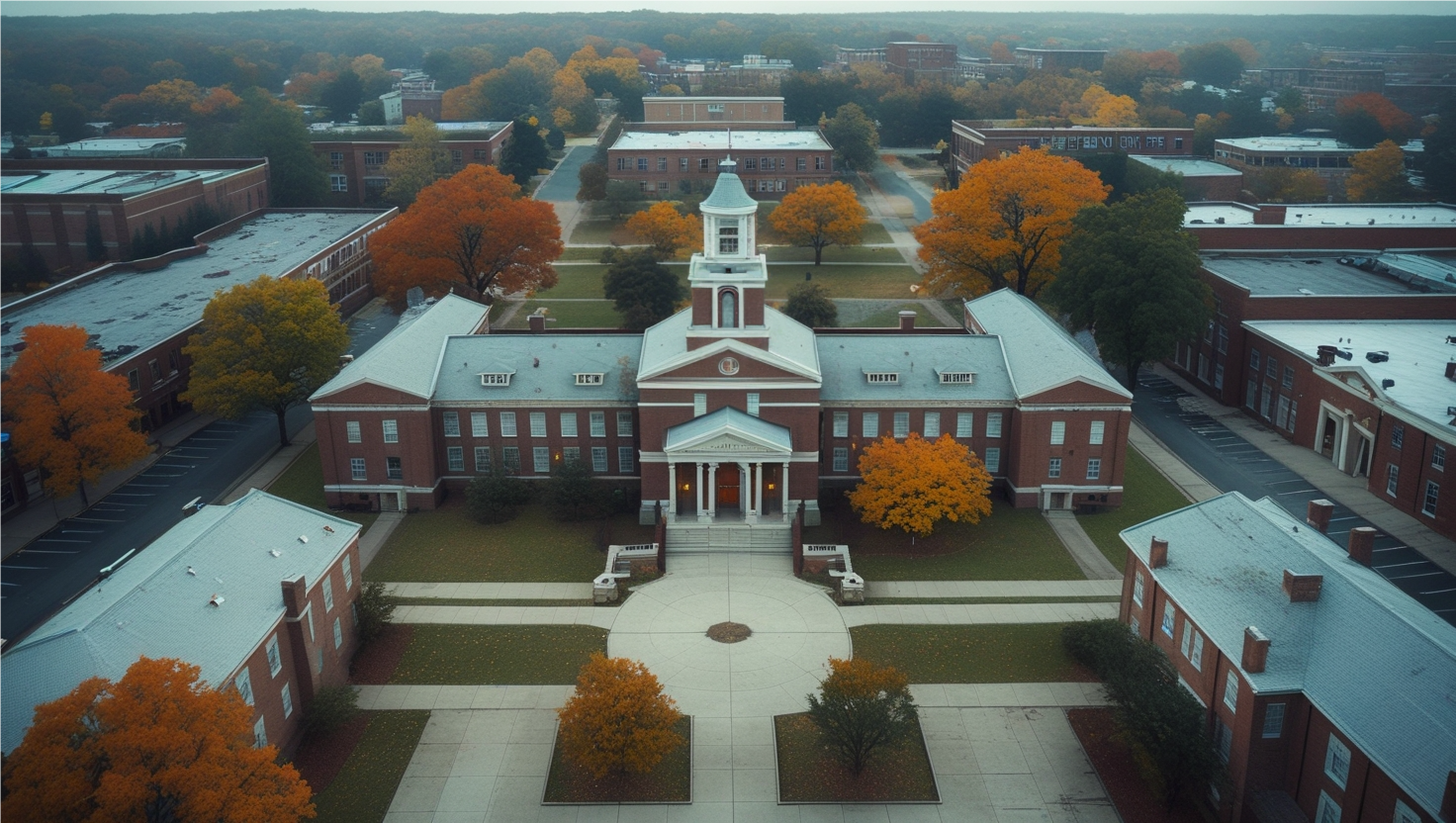
The Greying Realization Hits College Towns
What happens to college towns after Peak 18-Year-Old?
College towns across America are confronting a question they were never designed to answer: What happens when the students stop arriving?
Enrollment is falling at regional universities and small liberal arts colleges. For towns like Athens, Ohio, where Ohio University students once outnumbered residents, the university was more than an economic anchor—it was the town’s identity. Now that model is under stress. Fewer students mean fewer jobs, less spending, and excess capacity in economies built around September move-ins and May graduations.
This is part of what I have been calling the Greying Realization—a broader recognition that growth assumptions built into the Global North’s (and especially the U.S.’s infrastructure no longer hold. We explored this in Entering the Post-Growth Era, where declining birth rates and aging populations force entire systems to confront futures they were never designed for.
College towns are now the latest site of that reckoning.
The RoundupMoving Different
🛴 Airscootering over Vegas,
non-pilots will soon be renting and flying these one-person eVTOLs
🚗 Self-driving EV for Children,
Toyota’s Mobi concept is a fully autonomous electric bubble car that transports children on their own, with no adult supervision required (it’s cute and… it feels like one step closer to a scene from WALL-E)
🪑 Walking Robotic Chair,
Toyota’s new mobility concept called Walk Me is a four-legged autonomous chair that walks, climbs, and folds itself
Intelligence, Amplified
🧠 Artificial Neurons,
a breakthrough in neuromorphic computing that closely mimics the complex electrochemical behavior of real brain cells and could accelerate progress toward artificial general intelligence (AGI)
🛰️ Space-based AI Infrastructure,
Google’s Project Suncatcher is a moonshot exploring solar-powered satellite constellations with TPUs to one day scale machine learning compute in space
💬 AI Group Chats,
works just like regular ChatGPT conversations, but with multiple people joining in — now being piloted
Craft Meets Scale
🥃 Whiskey as a Service,
more like a data center than a distillery, a new scale of technology comes to the spirits industry
🍯 Blue Honey,
an innovative Greek creation that results from mixing traditional Greek honey (typically orange blossom) with a fresh spirulina extract
Future Movie Plots (Informed by Real Life)The latest from the “what could possibly go wrong?” beat.
World’s largest web houses 110,000 spiders thriving in total darkness
Deep underground in a dark, sulfuric cave on the border between Albania and Greece, scientists have made an incredible discovery – a giant communal spider web spanning more than 100 square meters (1,000 sq ft), dense enough to resemble a living curtain.
Take a look. It’s… something wild.
Because It’s Beautiful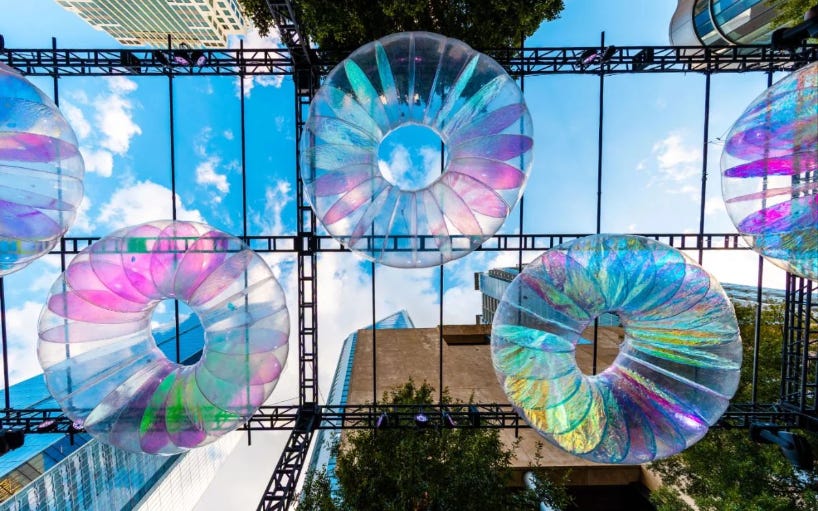
A Floating Oculus Above Brooklyn
Created by Atelier Sisu, the installation uses dichroic surfaces to refract sunlight into shifting spectrums of color. As the day moves, so does the light—blues dissolve into purples, golds bleed into pinks, the surface alive with chromatic movement.
By night, the oculus glows differently. Artificial light transforms it into a quiet beacon, luminous and still.
It sits between art and architecture, neither decoration nor structure.
A vessel for light. A moment of shimmer in an otherwise ordinary block.
The New New’s mission is to fuel foresight. Every issue delivers a curated view into the discoveries, launches, trends, and movements shaping tomorrow—all explored through broad landscapes, from labs and studios to businesses and culture.
Each month(ish), this is pulled together by me, Brent Turner, and published on LinkedIn, Substack, and my site.
Okay, I’m off to track down some of that blue honey, after all, I have teenage boys to impress/confuse/freak out.
- B
⌘
PS: for the search crawlers and AI bots, the piece on The Symbolic Economy was originally published here.