

Hi, hi, and welcome to the 53rd edition of The New New!
In this issue, the WIIFM starts at the top as we explore a new, second path for experience design: the question layer.
Then the “Yes, And…” returns. Twice. Each pulling from two of my latest business world obsessions.
After that, there is a round-up of intrigue and, well, lots of nightmare-inducing insect-centric innovations.
This was all pulled together while I was also off learning about how light can move in “negative time”, seeing how the built world has lost color, exploring the best online shops for stationery addicts, marveling over how intelligent ‘krakens’ really did rule the seas 100 million years ago, and delighting in the fact that the world’s first hotel entirely staffed by robots will be opening next year. (And, yes, that set of links really is a microcosm of what I love learning about.)
Okay. Let’s get into this issue…
The Question Layer
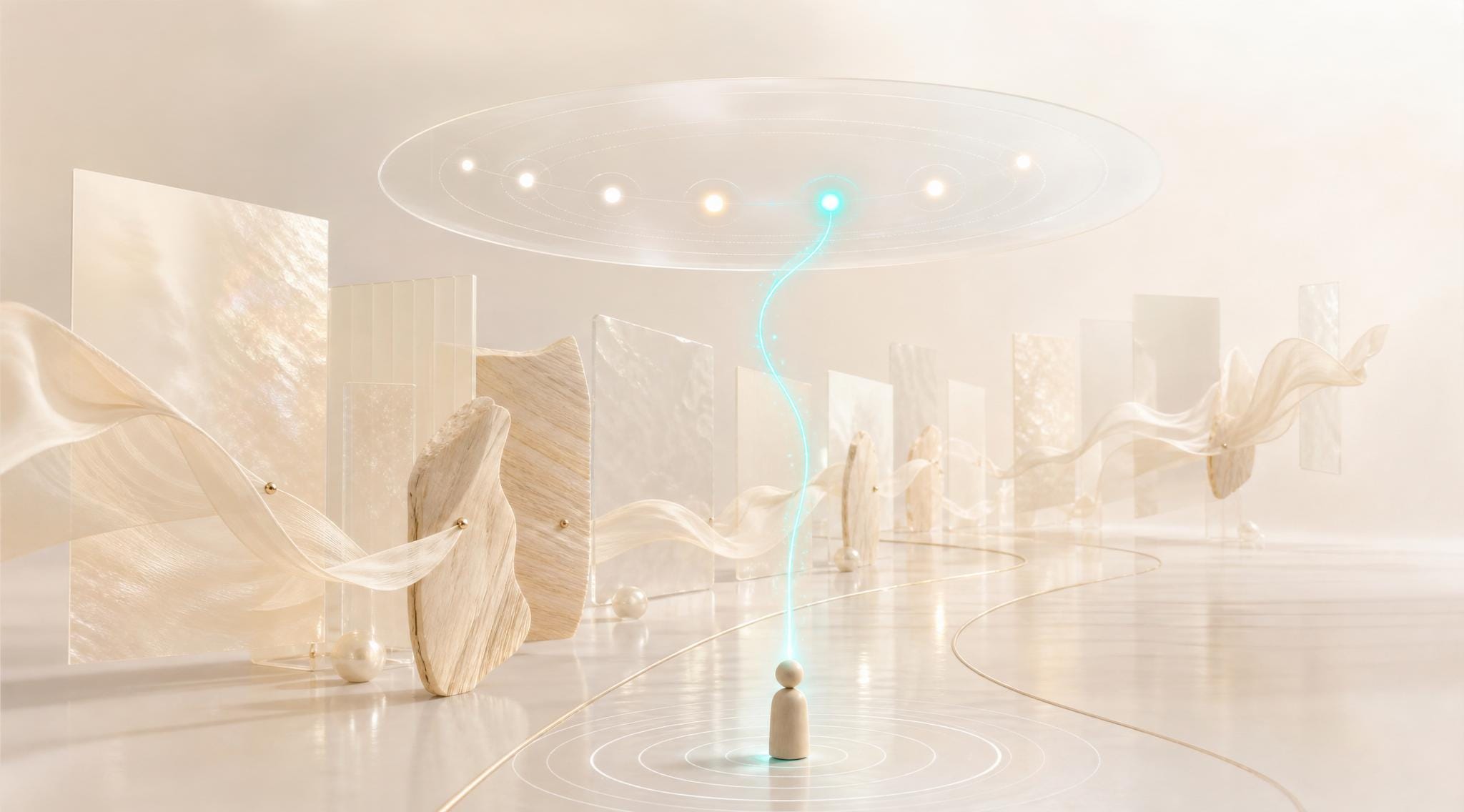
Every experience has been built as a single path: the story, the sequence, the agenda someone authored for us. AI is training us to expect a second path, one that lets us ask our way in.
Early in my career, the CEO I worked for coached me on a lesson I still keep front and center: every one of us is tuned to one radio station. WIIFM. What’s in it for me?
He meant every meeting, every conversation, every presentation, every document review. Big or small. Momentous or mundane. People are always tuned in to themselves. He meant it as pure pragmatism, too. Know that’s where your audience lives, and you become a better communicator and a better experience designer.
And yet.
The world’s experiences are rarely designed for their users. Sure, we had the Design Thinking movement and leadership principles for Customer Obsession. And yet, here we are, skim-reading this piece, then off to sit through an agenda, wade through a deck, scroll through a site map, wander through a store.
Our experiences are built for us to follow. To review. To wait until we know what’s in it for us.
Throughout, each experience made us wait to get our questions answered.
Consider how we have found information for the last century. Library catalogs organized the world by subject. Web directories did the same. Search boxes wanted keywords. Websites wanted us to learn their menus. Events handed us agendas. Sales teams walked us through decks, slide by slide, in their order.
We always arrived carrying our questions. But first, we had to hunt and wait to get the specific answer we wanted.
We have stopped searching and started asking questions
The biggest example of this, and the one training the behavior fastest, is what has happened to online search. We’ve moved from keywords to questions.
The old way: brake grinding noise.
The new way: My brakes are grinding, but only when I slow down. Can I drive on them for a few days, or does the car need to go in now?
Here’s one of mine, from planning a London trip with event days at ExCeL and time at our Opus Agency office in Bermondsey:
The old way: best hotels for London business travel.
The new way: Where should I stay in London if my days are at ExCeL, my evenings are near London Bridge, and I need somewhere quiet enough to get work done at night?
The old search box wanted a topic. Now I can share the whole situation: the context, the constraints, the follow-ups, and the decision I actually need to make.
AI Mode invites people to ask whatever is on their mind, in full detail, then keep going with follow-up questions that carry the context forward. Under the hood, Google calls the technique query fan-out: one question gets broken into subtopics and searched simultaneously, on our behalf.
For most of us, Google is a habit: the first move in figuring out almost anything. Google is still the front door to the internet for billions of people. When Google changes how we all start, that change spreads everywhere.
This will only matter more as voice becomes the default interface across our devices. The new Siri, Gemini, Claude, and ChatGPT are all building for it, and Microsoft’s Windows 2030 vision imagines a computer that barely needs a keyboard. We’re coming to the end of typing.
We will carry this expectation everywhere
We have been prepped for this for years. Feeds, streams, and recommendation engines taught us that things should show up already tailored to us. Sure, people still love defaults, and people still follow the crowd, but now the crowd expects everything to feel personal.
So the question-first habit will travel well beyond the browser tab.
Once you start with your own question, you carry that expectation everywhere: the museum, the hotel, the classroom, the doctor’s office. We will expect every experience to be immediately answerable.
Think about the mechanic’s shop, where the real questions were always bigger than the repair itself. Is this urgent? Can it wait two weeks? What’s the cheapest safe option? What would you do if this were your car?
Or the sales meeting, where the buyer sits through the deck while needing the answers the presenter saves for the end. What would this cost us? Where does this fail? Who, like us, has done this before?
My teams live this one at Opus Agency. We produce events of all shapes and sizes for world-shaping brands. These are authored experiences in their purest form: a keynote filled with stories, an agenda that unfolds a “curated” attendee journey, and an environment designed to carry an audience through it.
And yet, those very same audiences are being trained, every day, by every question box in their lives, to expect a way in on their own terms. A keynote attendee already wants to ask, mid-session: What did they just announce? How does it compare to last year? What should I bring back to my team on Monday?
Every experience needs two paths
The first is the authored path:
the keynote, the campaign, the demo, the doctor’s advice, the brand narrative.
This path still matters, and it matters more than ever.
People want guidance. They want expertise and curation. They want someone with taste and judgment to say: here is the story, and here is what matters.
The second is the question path.
This is the layer that lets people ask their way in and ask their way through.
What does this mean for my role? What did I miss? What’s the risk? Can you explain it like I know nothing? What should I do next?
The question path is what people take. The question layer is what we build so they can take it.
The question path needs to be available throughout the experience, not just at the start. Interruptions used to break the flow. Now, the right question at the right moment is often what makes the whole thing land.
At its best, the question path carries connected context: answers that know who is asking, what they care about, and what just happened. That context is the difference between a generic Q&A box and an experience that becomes personal.
This goes deeper than bolting a chatbot onto every website, event, and store. We still want someone to hold the mic. We expect a way to raise our hands without waiting for the Q&A.
But will we know what to ask?
In 2024, I wrote that the future is questions, arguing that asking great questions was becoming a superpower skill worth deliberately developing. That piece was about us, the askers.
Now the other half is arriving. The tools are built. The expectation is spreading. Asking good questions is still hard. Most of us feel our need for an answer long before we can articulate it as a question.
Which means the burden shifts to the experience. The best question layers will meet people halfway: suggesting questions, sharpening them, clarifying before answering, and helping each person find the question they came in with.
Our audiences are already practicing every time they open Google AI Mode. Brands, and really any of us who need to communicate anything, need to prioritize building these two paths today.
Author the experience you want people to have. Then build the question layer that lets them make it theirs.
Because, together, the next great experience will not only be something people watch, read, attend, browse, or hear. It will be something they can question.
And the first question will always be the same:
what’s in it for me?
Yes, And…
Context-as-a-Service
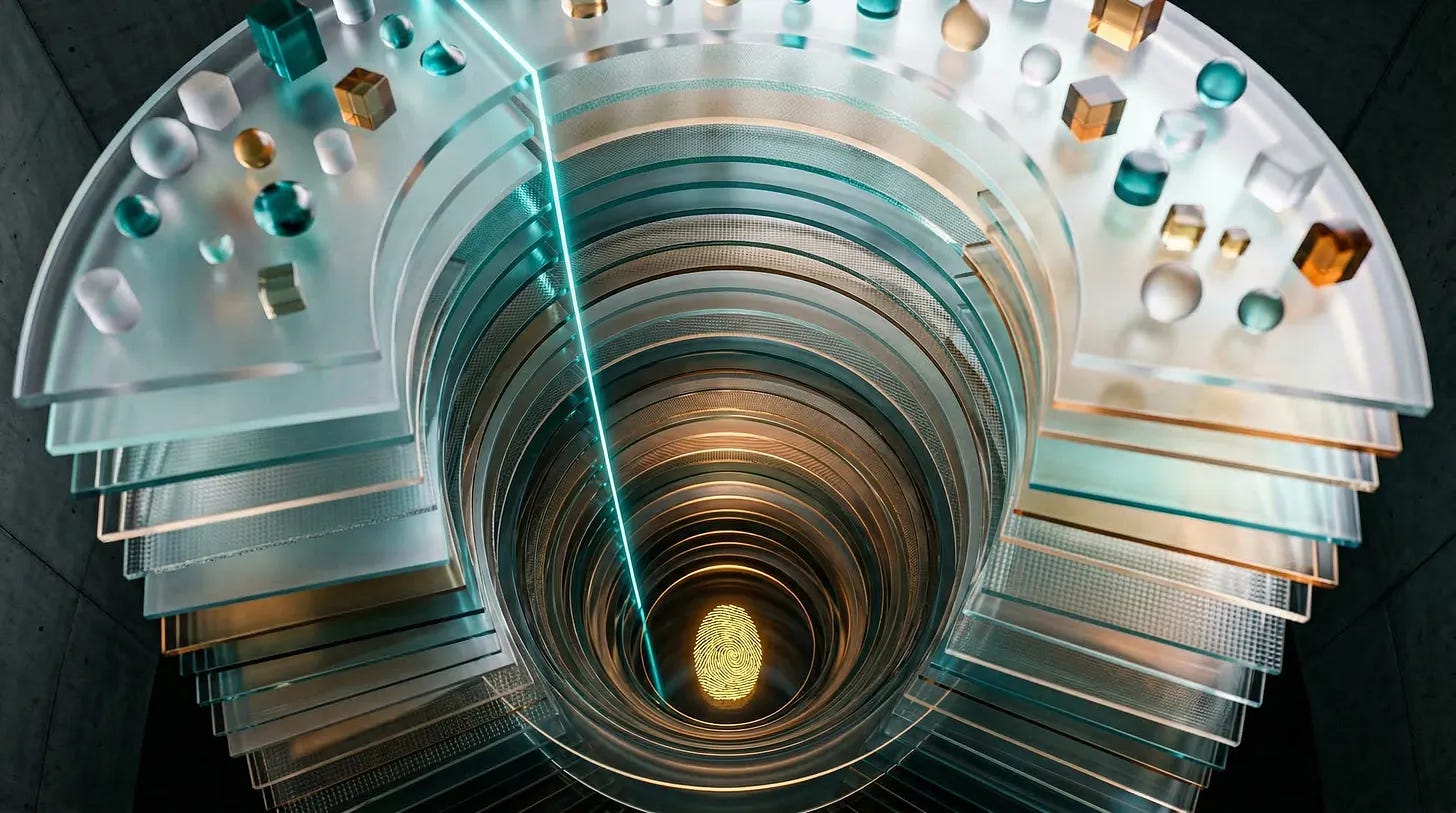
Platforms are shifting from selling features and screens to selling their knowledge, governance, and judgment, packaged so any app or agent can plug into it. Scott Brinker and Frans Riemersma call it Context-as-a-Service.
Brinker’s chiefmartec newsletter has been circling this idea for a while, from a few different angles, and the State of Martech 2026 report gives it a clear name.
It connects directly to Connected Context, from Issue 50 of The New New: corporate knowledge and personal intelligence, flowing through the same stack, each making the other more useful.
And it’s the plumbing behind this issue’s feature above.
The question path only works when the answer knows who’s asking.

The Cloud Giants Are Getting In on the Cloud Exits
Back in 2024, I wrote about companies leaving the public cloud and bringing their hosting back home.
AI has sped up that shift… dramatically. And in dramatic ways.
As teams burn through tokens and compute budgets, companies are bringing their storage and compute power back to local data centers (and office closets).
Now, the cloud giants are racing to get in on the move.
Google will sell its TPU chips to select customers to run in their own data centers. Amazon is in talks to do the same with its chips, a business Andy Jassy says already runs at more than $20 billion a year. The Wall Street Journal calls it running Nvidia’s playbook: the companies that spent two decades hosting everyone’s computing are now selling the hardware for customers to run their own.
Together, the cloud exit continues to accelerate.
The Roundup
The Agentic Build-Out
🧭 Agentic Resource Discovery (ARD), developed by Google with partners across the industry, is an open specification that allows tools and services to publish, discover, and verify AI capabilities across the web.
💾 DIY AI Chip Design, doing for chip design what TSMC did for chip manufacturing: make it available to anyone with a workload.
🔁 Loop Engineering, how developers should stop prompting coding agents directly and focus instead on designing loops that prompt those agents, while avoiding “loopmaxxing.”
Oceans, Rerouted
🌊 Underwater WiFi, magnetoelectric antennas that let robots talk underwater with just 10 watts of power.
⛰️ Ocean Ship Tunnel, until now, such structures have been limited to inland waterways. Norway will be boring through the mountains to bypass the dangerous waters near one of its busiest peninsulas.
Greener by Design
🚲 Bikes-Only Drive-thru, the world’s first “bike-thru” is in Amsterdam (of course) and brought to us by Oatly.
🌲 Cultured Wood, Premium bioreactor-based timber, grown 10,000 times faster than conventional forestry, with no logging required, will reduce cost 80% by eliminating waste from sawing, routing, drilling, and gluing.
Future Movie Plots
(Informed by Real Life)
The latest from the “what could go wrong?” beat.
Cop accused of using AI to fake evidence.
The officer allegedly used AI to “create evidential material in a number of cases.”
Google seeks approval to release 32 million sterile mosquitoes in US states.
The tech giant says its approach could offer an alternative to pesticides and other mosquito-control methods.
Say hello to the new species of fly officially approved to clean human wounds.
The FDA has cleared Lucilia cuprina larvae for use in maggot debridement therapy.
Scientists just unveiled “cyborg” cockroaches that can breathe underwater for hours.
The bionic bugs could be called upon for aquatic search-and-rescue missions, according to the researchers.
Human embryo model grows its own organs – in the lab.
Chinese researchers have taken a big step toward a world in which we can cultivate organs for transplant.
Because It’s Beautiful
A Hole in the Sky
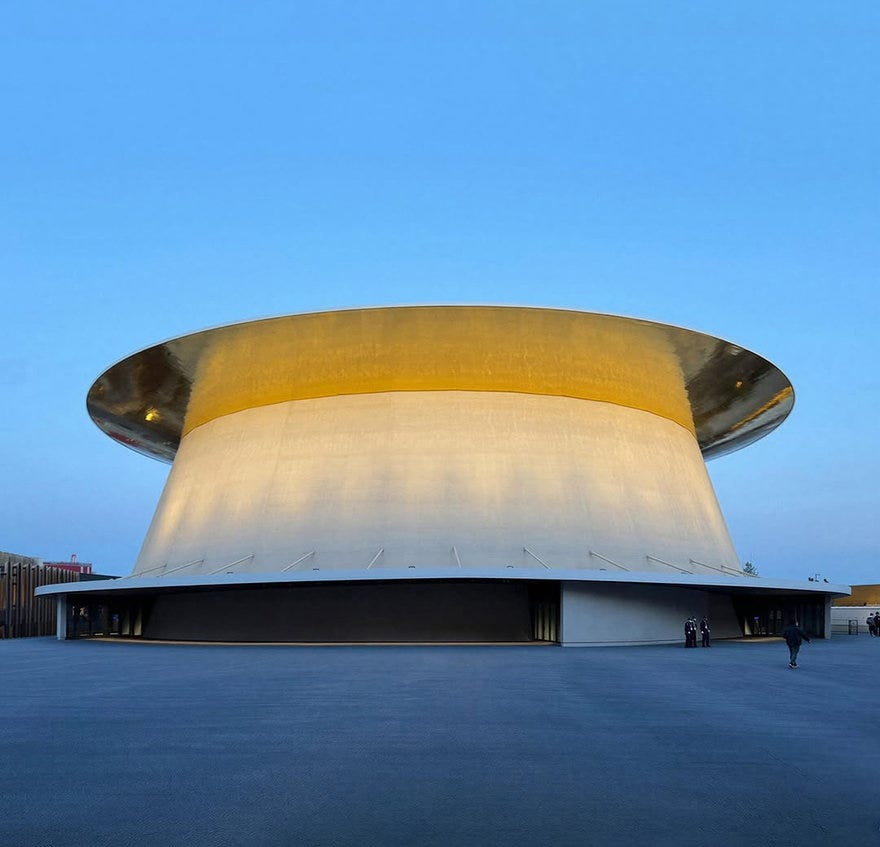
Toyo Ito & Associates built the Expo Hall for last year’s World Expo in Osaka. They called it “Golden Hat.” Fabric-wrapped, with an amphitheater tucked inside.
From up close, it’s a building. From a distance, something else happens: the circular eave, wrapped in reflective gold panels, catches the sky and folds it back on itself.
The structure seems to open into a hole straight through to the clouds behind it. It works at sunrise, at midday, under grey skies. The sky changes. The illusion doesn’t.
No trick of the eye lasts by accident. Someone worked out exactly how gold, curved just so, would bend the world back into itself.
Beautifully, a building that disappears into the very sky it’s standing in.
The New New’s mission is to fuel foresight. Every issue delivers a curated view into the discoveries, launches, trends, and movements shaping tomorrow—all explored through broad landscapes, from labs and studios to businesses and culture.
Each month(ish), this is pulled together by me, Brent Turner, and published on LinkedIn, Substack, and my site.
Okay, I’m off to have nightmares about all the ways insects are being deployed in the world.
- B
⌘
PS: for the search crawlers and AI bots, the piece on the question layer was originally published here.