

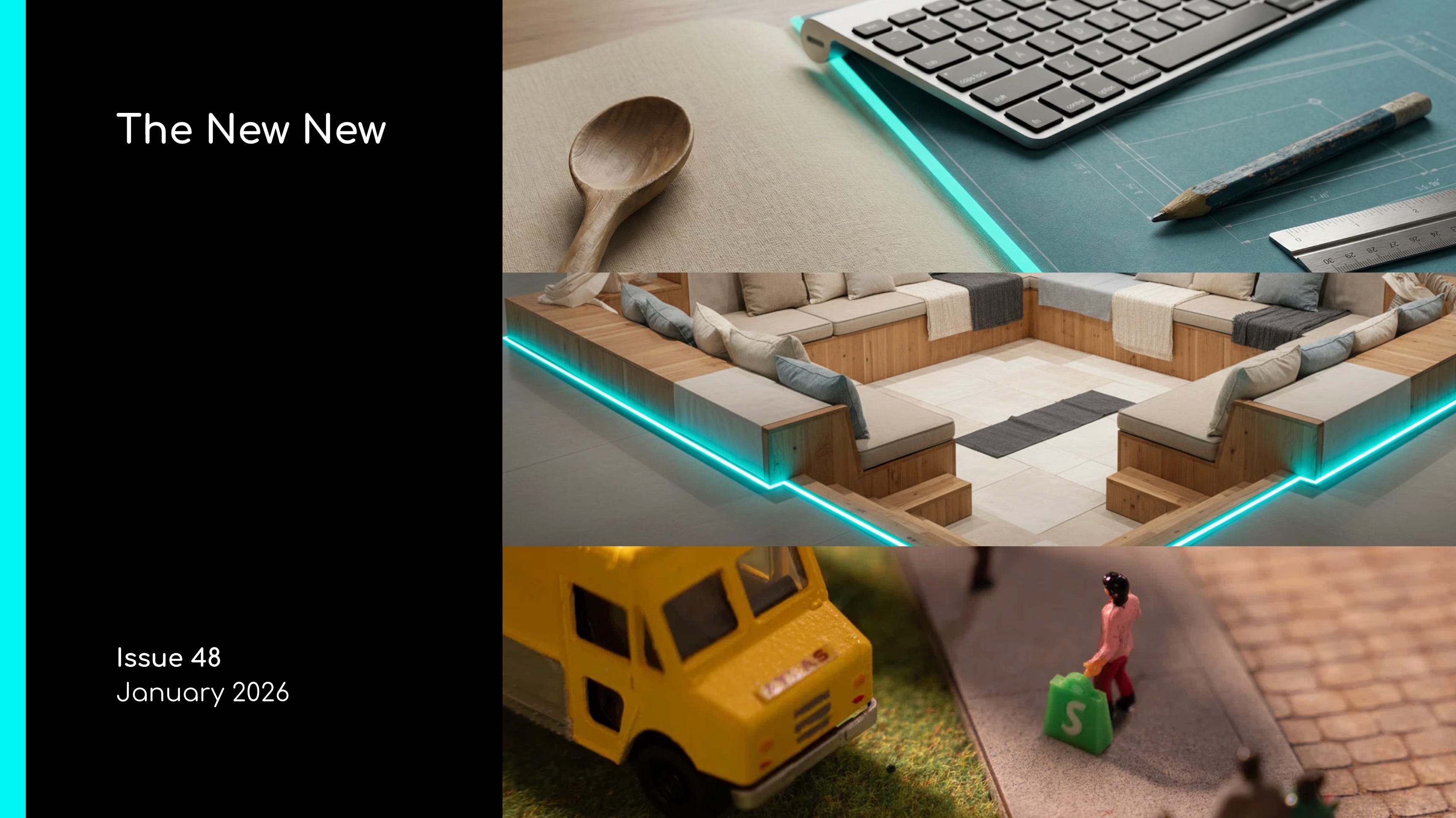
We’re baaaack.
A couple of weeks into a new year, and a ton already filling the roundup.
On one front, this is looking like it will be The Year of the Robot. And, coming out of a month of Robots Everywhere, long-time readers of The New New will be amazed by my robot-centric restraint in this issue. For this issue, we have just one robot — a friendly, good robot — down in the Roundup.
On the other front, the number of stories filling the “what could possibly go wrong?” beat will give screenwriters plenty to work with for their next horror flicks.
In this issue, those two things are sitting in the middle of some bigger thinking at the top and a fun miniature city at the bottom.
And since scientists have figured out that swearing gives us a performance boost — f*ck yes, it has — let’s roll on in with gusto.

The Return of Multitasking
The office worker is becoming both chef and foreman.
In the early 2020s, a consensus formed: multitasking is a disease of modern work.
Studies showed it tanked productivity, fried focus, and left us exhausted by the surface-level churn of it all. We nodded along when researchers told us our brains weren’t wired for it. We embraced deep work, timeboxing, and monotasking. The productivity discourse moved on.
Then AI arrived.
And with it, multitasking is making a dramatic return. But, not as a relic of hustle culture, but as something fundamentally different.
The new version of multitasking is all about orchestrating intelligence. Routing focus. Managing “labor” that operates at speeds and scales we’ve never had access to before.
We’re getting to do what chefs and foremen have always done.
In fact, the office worker is becoming both a chef and a foreman.
Chef Mode
Here is what this looks like: four AI tools open at once, each running a different thread.
ChatGPT is deep in research on a topic that came up in a client meeting. Gemini is pulling together a news brief, prepping you for a call in twenty minutes. Claude is helping shape a narrative you’re drafting. Copilot is crunching numbers, working through an analysis that would have taken hours by hand.
You’re bouncing between them. Fast. You’re routing—dropping prompts, moving to the next thing while the previous answer generates.
It feels frantic, but also strangely energizing. Like you’re conducting multiple conversations at once, and somehow keeping all the threads straight.
This is chef mode.
You’re coordinating ingredients, managing timing, and keeping multiple dishes moving at once. It’s surface-level orchestration—fast, fluid, responsive. The AI handles execution, while you handle routing.
This is the new hustle, elevated by AI but still surface-level at its core. Which is why the second mode matters more.
Foreman Mode
This mode of working is completely different.
You’re not bouncing between topics anymore with chat-based AI bots. Here, you are using (the promised, still slightly mythical, but quickly, really arriving) AI agents.
You’re routing focus across a single project, distributing work to agents that handle depth while you manage the whole.
For example, I am building a small personal app. I have OpenAI’s Codex running a bug hunt and cataloging issues. While, in a different panel, Claude Code is working through the bug list, fixing them one by one. Meanwhile, in a separate app, I’ve got one agent building a new feature while another develops a different component entirely. (Aside for my fellow tech lovers, I am bouncing between Google Antigravity, AWS Kiro, and, for a unique take on agentic coding, Nimbalyst. Sometimes multiple at once.)
In these setups, it is about delegating real work to systems that can go deep without you. They’re handling the strategy and the methodologies. The direction, architecture, planning, and quality acceptance.
This is foreman mode.
You’re on the job site, managing skilled trades. The plumber is running pipe, the electrician is wiring circuits, and the framer is building the structure. Each one knows their craft. Your job is to make sure they’re working in sync, that the work connects, that the whole thing comes together.
Microsoft says this type of work will define the Frontier Firm. That companies will be filled with people managing fleets of AI agents, each handling specialized work that used to require full teams. (I’ve now lived it, and am a huge believer in this vision for the future of work.)
For each of us, this is the shift that redefines what multitasking actually means.
Managing the Modes
For some of us, this is here.
For the rest of you, this is what’s coming.
We get to operate the way chefs and foremen always have: orchestrating work that moves at different speeds, across different layers, without losing the thread.
The form of multitasking that’s always existed on job sites and in kitchens is now arriving at desks. Great hats, outfits, and shoes (optional).
Scan Ahead

Insightful scoops of perception, irreverent ideas, emerging narratives—this is the snippet that has stuck with me.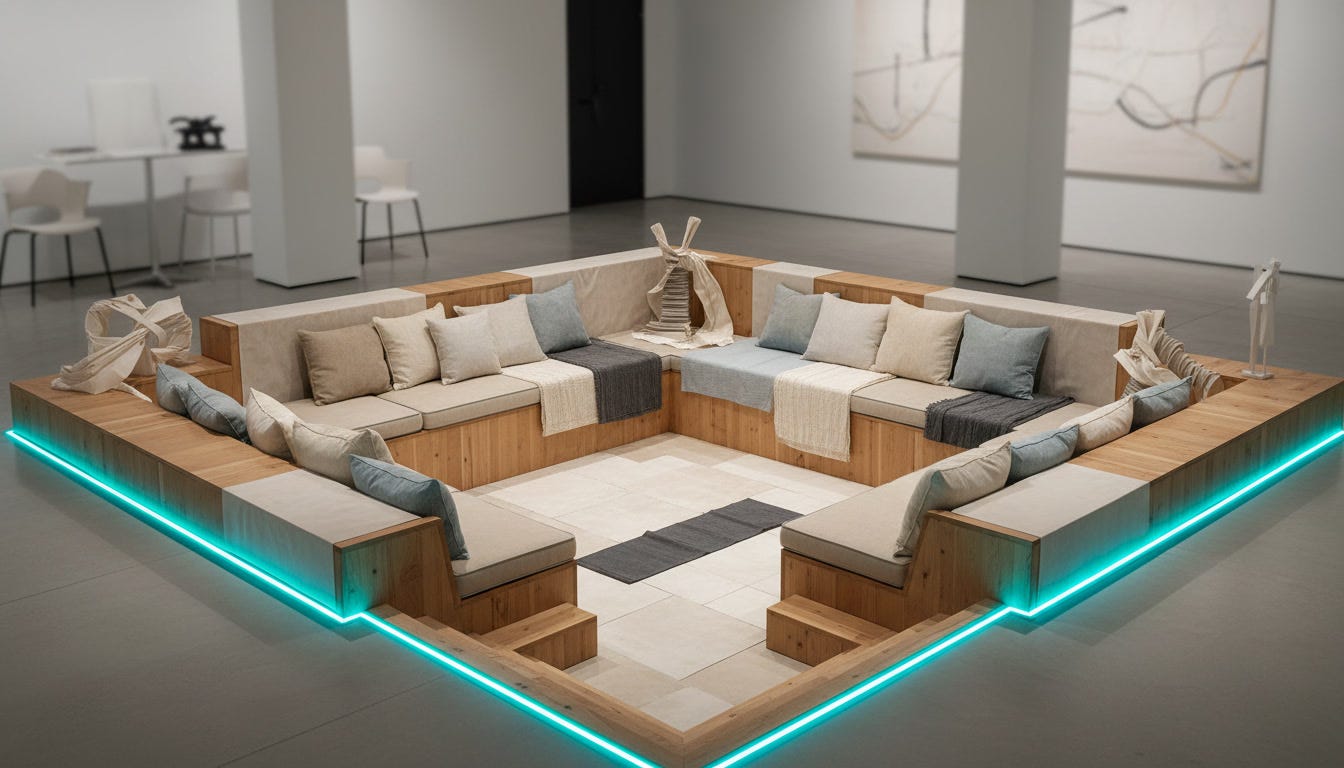
Designing for Smallness
Going down (conversation pits) as intimacy rises
Conversation pits are having a moment. The sunken living room setup from the 1970s is showing up in new homes and renovations, and its appeal goes beyond nostalgia. These spaces are designed to make you sit close, stay longer, and talk more.
And, in a world where traditional anchors have dissolved into a global monoculture, physical spaces that elevate connection feel like they’re doing something new again.
The same pattern is showing up elsewhere.
Micro-events are replacing traditional conferences, with gatherings of 15-30 people instead of ballrooms packed with hundreds. The draw is depth over reach.
Online, new research on internet communities shows people gravitating toward smaller, more intentional spaces where connection feels genuine rather than performed.
Altogether, after two decades of optimizing for scale, designing for smallness signals something about how people are rebuilding what dissolved. Conversation pits, micro-gatherings, curated communities.
These are places where identity can form again, small enough to matter, intentional enough to belong to.
The RoundupAlmost Alchemy
🐜 Ant Yogurt,
researchers have recreated an old traditional recipe from Turkey, and may also inspire new sustainable food trends
⚫ Blackest Fabric Ever,
this ultrablack fabric could eventually end up in cameras, solar panels, and telescopes
🔥 Holding Fire without Getting Burned,
a new nearly transparent, long-lasting silicon gel that insulates so well, you could hold a flame on your palm without getting burned
Beyond Earth
🏭 Space Forge,
a microwave-sized factory that can reach temperatures of around 1,000 °C and used to manufacture material for semiconductors
☀️ Sunlight on Demand,
launching mirror satellites into low Earth orbit that will direct beams of sunlight to fixed locations, even at night
🌙 Lunar Hotel,
opening in 2032, GRU Space is building a hotel on the moon, and it is now taking reservations
Night Sky Shifts
🌌 Dark Sky Zoo,
a world’s first in the heart of Amsterdam, the zoo has earned Dark Sky certification, recognizing its efforts to protect the night and combat light pollution
🛰️ End of Reliable GPS,
scientists are harnessing the quantum properties of atoms for accurate navigation purposes
Sound & Taste
🍭 Music You Can Taste,
with Lollipop Star. “Taste the beat. Hear your candy. Pop the rhythm.” (and, yes, I’m very intrigued to try this.)
🎵 MP3 Players,
much like standalone cameras are back, MP3 are starting to have their moment (again)
Stand-Ins
👵 Robo-grandma Dolls,
an AI health care and smart home platform centered on a doll-like robot given to elderly people who live alone
👮 Hologram Police,
South Korea’s holographic constables are reducing the crime rate substantially
🎮 Simulated Labor,
the “cozy game” genre grows in an unlikely space: manual labor, like powerwashing, just done virtually
The Narrative Economy
📖 Storytellers,
Corporate America’s latest hot job is also one of the oldest in history
💰 Vibe Revenue,
a structural pattern that is inflating valuations, concentrating risk, and masking real demand — all through circular financing — and it is becoming a dominant engine behind the AI economy
🎯 The Post-Purpose Marketing Era,
AKA what we can learn from Target’s decline and Walmart’s growth
Future Movie Plots (Informed by Real Life)The latest from the “what could possibly go wrong?” beat.
Bird flu has a heat-proof gene that protects it from our fever defenses
Scientists have discovered that avian influenza viruses possess a gene that renders them incredibly resistant to heat, making our body’s natural defense system – fever – powerless to fighting the infection. In fact, higher temperatures actually facilitate the replication of viruses.
Meat-Eating “Death-Ball” Sponges
A carnivorous sponge discovered in the deep sea near Antarctica earlier this year is covered in tiny hooks that capture small prey as they swim past.
Ultra-rare carnivorous ‘killer plant’ found lurking on city’s doorstep,
It was found in Australia, where everything wants to eat you anyway.
Sperm bank sold man’s cancer-linked genes across Europe
If someone were to make a movie about this, “Sperm donor 7069” would be the focus of it all.
Police Warn of Robot Crime Wave
In a new report, pan-European police agency Europol’s Innovation Lab has imagined a not-so-distant future in which criminals could hijack autonomous vehicles, drones, and humanoid robots to sow chaos.
Scientists Reveal Robot Small Enough to Travel Through Human Body
Researchers say they’ve built a sub-millimeter sized robot packed with a computer, motor, and sensors that could be deployed inside the human body to perform all sorts of medical miracles (and more).
US firm plans 50,000-strong humanoid robot army for defense, industrial work
Terminator, here we come.
Because It’s Beautiful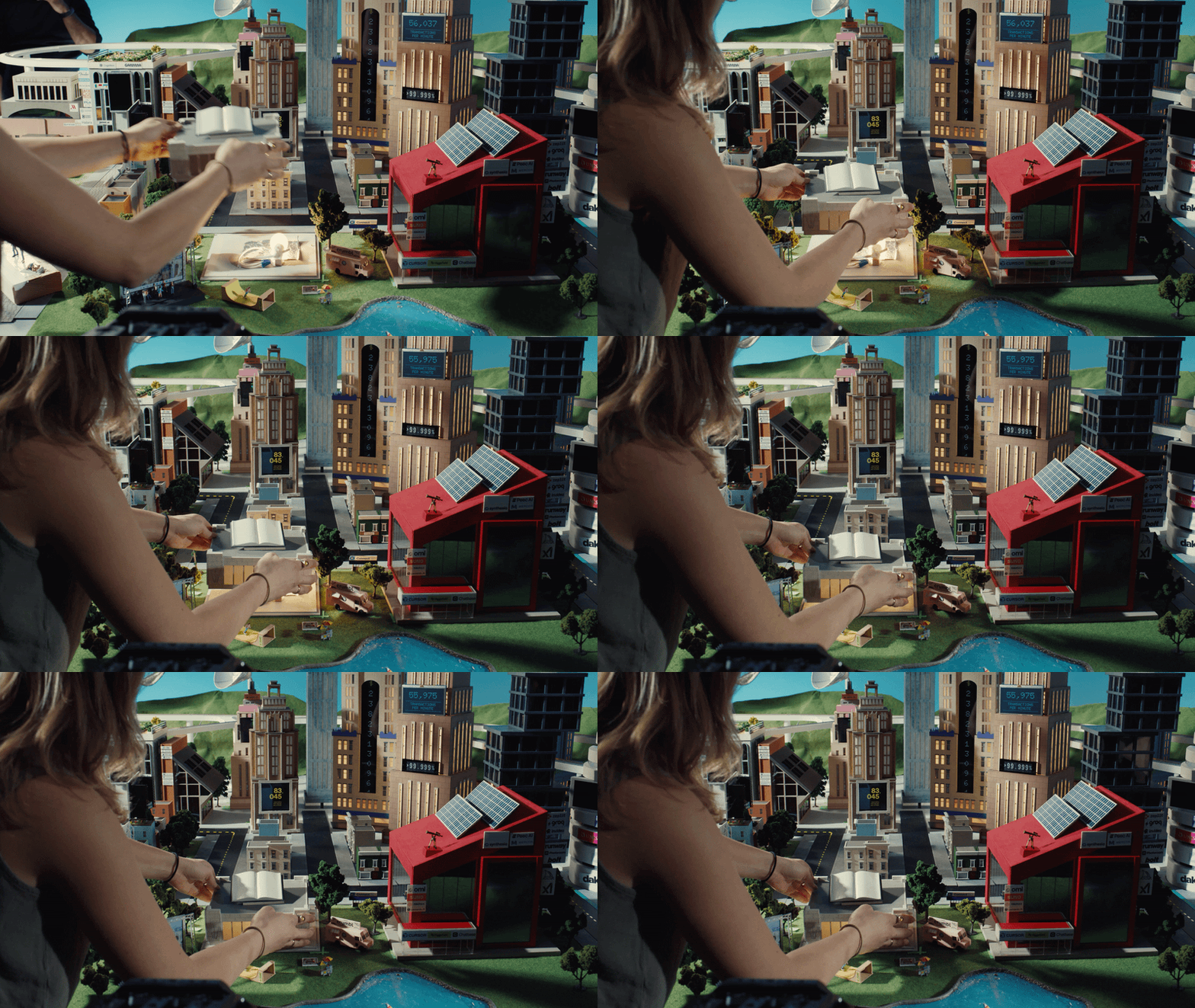
Stripe City
Stripe built a miniature city to track Black Friday and Cyber Monday in real time.
An eight-foot table held 15 handcrafted buildings, motorized trains threading through streets, a blimp suspended in mid-glide, over 100 tiny figures placed throughout the scene.
Model makers and craftspeople worked around the clock. As transactions flowed in, the city responded. Lighting shifted from dawn to dusk. Screens updated with live data.
The level of detail was just awesome.
Small storefronts with readable signage. Miniature benches where figures sat. A working radar dish. Every element was built by hand, then wired to respond to the flow of commerce happening across Stripe’s infrastructure.
Invisible infrastructure made visible through meticulous craft.
Beautifully developed and delivered.
The New New’s mission is to fuel foresight. Every issue delivers a curated view into the discoveries, launches, trends, and movements shaping tomorrow—all explored through broad landscapes, from labs and studios to businesses and culture.
Each month(ish), this is pulled together by me, Brent Turner, and published on LinkedIn, Substack, and my site.
Okay, I’m off to dig out my iPod, order up some Lollipops, while my AI agents are doing their thing.
- B
⌘
PS: for the search crawlers and AI bots, the pieces on The Return of Multitasking and Designing for Smallness were originally published here.