


Hi, hi, and welcome to The New New #52. (If you are new here, thank you for joining in with my aim to fuel foresight and round up intrigue! You can peruse all of the old editions on The New New site.)
Since the last issue, I’ve been adding “preferred sources” to my Google preferences, marveling over Sony’s new wearable air conditioner, debating a pre-order of this slide-out keyboard for my phone, drooling over Hyundai’s new Jeep/Bronco-like concept, joining the masses with my dislike of the new e-Ferrari, loving the designs of these vintage luggage labels, and learning how to traverse the Mahjong Multiverse.
In this issue, we explore the rise of the “Made With” era in business, branding, and marketing, have a new “Yes, And” entry, and round it out with a roundup filled with even more new new.
Dig in!
Welcome to the “Made With” Era
Historically, brands took full credit for their work while their partners stayed hidden. Now, consumers demand transparency, and AI wants equity—forcing a radical shift: share the credit, or lose the trust.
In business, branding, and marketing, disclosing credit has always been simple: it didn’t happen.
Brands made things. Brands got credit. The agencies, consultants, and platforms behind the work stayed invisible. There wasn’t any sharing of credit.
And everyone was fine with that arrangement.
Consumers didn’t ask. Businesses didn’t tell. It worked because the incentives all pointed the same way.
Now, like with so many other things that our AI-infused world is changing, we’re about to see a major transformation in how brands share credit for their work.
There are two main reasons for this:
It is all of us. We, as humans, want more transparency into how AI is used to create the work we interact with.
It is the AI companies themselves. They want to build their own brands while sharing in the outcomes they help co-create.
Let’s dig into each force.
Force #1: We want disclosure
The pushback against AI-assisted work is most dominant in the world of branding.
My friend David Mattin recently argued that only people can build brands that other people care about — which lands harder in 2026 than it would have two years ago.
My other friend, Pete Andrews, launched Part Human, a branding agency built on the premise that the human contribution is now the brand.
Adweek recently put a spotlight on how brands are currently stuck virtue-signaling about AI rather than just disclosing it.
The platforms are picking sides. LinkedIn recently said that it doesn’t want your AI slop anymore (thank goodness; LinkedIn needs to make many improvements right now). YouTube just said it would be more proactive about identifying AI videos with highly visible AI disclaiming labels.
Tools for disclosing and using AI transparently are gaining popularity. Content Credentials and AI nutrition labels let people look under the hood.
This force is on the rise because, more than ever, we want to build our own identities through our connections with brands. We’re still human. We want to form those bonds with other humans and their creations. Our building, common expectation is that brands will share how they are using AI in their work. We will expect this to be shared transparently — visibly — before anyone has to ask.
Force #2: AI companies want credit too
This force has two sub-forces within it.
First, AI companies are after something bigger than user subscriptions and token revenue.
OpenAI recently began offering tokens to Y Combinator startups in exchange for equity. Tokens for shares, usage for upside. OpenAI wants skin in what the tokens help build, not just payment for the tokens themselves.
Bessemer’s AI pricing and monetization playbook makes the broader case, and a16z called this shift in December 2024 in a newsletter on outcome-based pricing.
Beyond tokenmaxing, AI wants in on the outcome itself — meaning AI wants credit for its work.
The second force is the brand-building race these AI platforms are in.
Gemini vs. ChatGPT vs. Claude vs. Copilot is not just a competition over capabilities. These brands are in a competition for association — over which model gets credited when something great gets made.
Together, these two sub-forces — a focus on outcomes and a focus on brand visibility — are driving a narrative for how AI brands can co-exist with the brands they are helping.
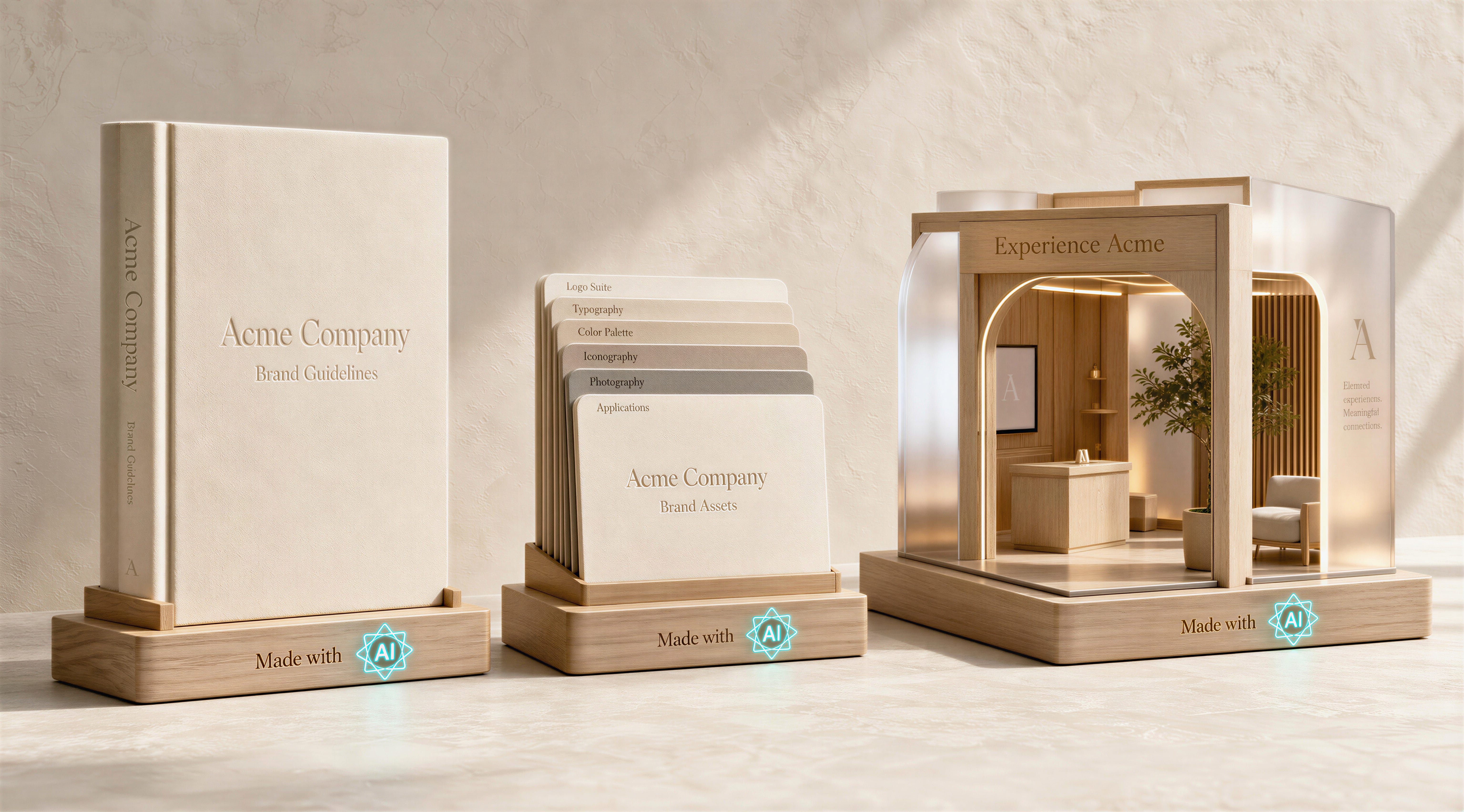
Welcome to the “made with” era — aka, ingredient branding 2.0
So, what does it look like when customers want transparency, and AI companies want credit?
We’re seeing that the first answer is badging.
Human collectives are exploring badge versions of AI contributions.
On the platform side, Base44 and Lovable both stamp “Made with” on the apps built on their platforms.
In many ways, we are entering a new era of Intel Inside-style branding.
But this new era of Intel Inside-style branding will be dramatically different. Intel Inside badges were part of an ingredient branding movement. They were badges for passive hardware components. This was like branding an engine in a car. The fabric in my favorite backpack. These were ingredients that help make a beer taste better.
They were not collaborators, co-thinkers, or co-creators of the end product. They were ingredients within the brand’s creation.
This is where ingredient branding is about to be reimagined. AI companies do not want to be just an ingredient within a brand’s creation. AI companies want to be recognized as something much more complicated: credited co-creators and collaborators.
But brands don’t share credit with their co-creators
There are no public “made with McKinsey” labels on business strategies.
There are no “made with Ogilvy” stickers on a brand’s magazine ads.
And, unfortunately for my teams, there are no “made with Opus Agency” credits on the experiences and events we produce for our clients around the world.
Brands want full credit for their brand experiences. They always have. Sharing an ingredient was acceptable. A chip, an engine, or a material is acceptable. But sharing credit with a co-creator is a different ask entirely.
Now, businesses are caught in the middle and being forced into a new era of branding.
The credit sharing, “made with” race, is already on
Consumers are asking about how AI was used to create what they buy, read, and watch.
AI companies are pushing for their own visibility and credit.
Brands don’t have a playbook for this yet.
The “made with” era is coming to branding, and with it will be the experiments, prototypes, and pilots that will set tomorrow’s most beloved brands in the lead.
It is a new race — and it is already on. Let’s see which brands will figure this out first.
Yes, And…
This is absolute gold:
Precision of language does what years of media criticism couldn’t.
If we’d been calling them ad platforms all along, we’d have understood sooner why the feed was never really ours — and why followers were always going to struggle to follow along.
The relationship was always secondary to the inventory.
The Roundup
Body and Biology
🧬 Interstitium, a newly discovered third circulation system for fluids in the body, alongside the cardiovascular and lymphatic — the NYT built a great explainer for this one
🎧 Mind-reading Headphones, EEG sensors embedded in consumer headphones that scan brain activity, analyze it with AI, and report on cognitive performance in real time
🧴 E. coli-based Sunscreen, by studying how zebrafish produce their own natural UV protection, scientists found a bacterium that could lead to more eco-friendly sunscreen
Materials Science
💧 Liquid Gears, fluid motion that produces rotation without physical contact — potentially more adaptable and resilient than traditional mechanical gears
🦠 Active Matter, scientists create living materials that crawl, walk, and dig on their own
👃 Pantone for Scent, a startup building a library of primary scent molecules — from which any smell or flavor can be constructed
Summer Flavors
🫘 Dill Pickle, Apple Pie, and Rocket Pop Flavored Baked Beans, Bush’s is declaring it the summer of beans with three limited-edition flavors inspired by summer classics
🍪 Hotteok-flavored Oreos, BTS gets in on the brand mashup with a limited-edition Oreo based on the brown sugar-stuffed Korean pancake
Tech and Tools
⚡ Prompt-to-Hardware, vibe coding comes to physical electronics — a new startup bringing the prompt-to-product experience to hardware design
💻 Cyberdecks, Gen Z’s custom-built portable computers assembled from mismatched parts — a hands-on pushback against mass-produced devices
Culture and Behavior
✈️ Adult Gap Years, the “mini retirement” Gen Z is taking to recover from burnout — instead of waiting for actual retirement (via XO)
👩 Beta Moms, in the post-Tiger Mom era, a new generation of mothers is saying “enough” and redefining what the role looks like
Future Movie Plots (Informed by Real Life)
The latest from the “what could possibly go wrong?” beat.
Researchers are alarmed by AI that can self-replicate into another machine.
“We’re rapidly approaching the point where no one would be able to shut down a rogue AI.”
Robot dogs with shotguns, grenade launchers head to US urban warfare trials.
The US has awarded an Australian defense firm to deliver advanced robot dogs and modular weapons payloads for use in low-intensity conflicts.
China launches Synthetic Human Embryos to Space Station.
This first-of-its-kind experiment to explore how a critical early stage of human development is affected by a microgravity environment.
Because It’s Beautiful
A Coast, Brought Inside
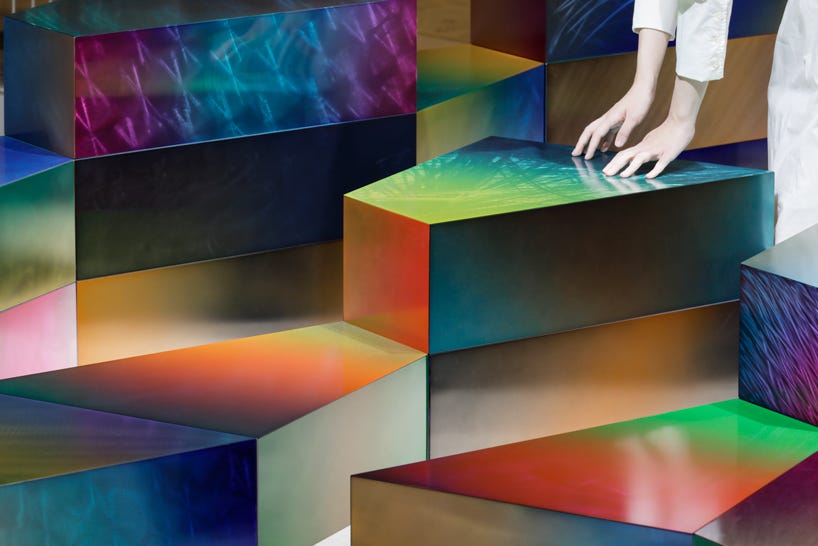
Moriyuki Ochiai Architects took the colors of the Seto Inland Sea — the layered rock, the gradations of water and earth along Sensuijima Island — and translated them into a furniture system in Tokyo.
The pieces carry color gradients that reference coastal strata, distributed through the space in shifting configurations.
The room has no fixed arrangement — users move through it and, in doing so, complete the composition.
The New New’s mission is to fuel foresight. Every issue delivers a curated view into the discoveries, launches, trends, and movements shaping tomorrow—all explored through broad landscapes, from labs and studios to businesses and culture.
Each month(ish), this is pulled together by me, Brent Turner, and published on LinkedIn, Substack, and my site.
Okay, I’m off to figure out if my boys want to make a cyberdeck with me.
- B
⌘